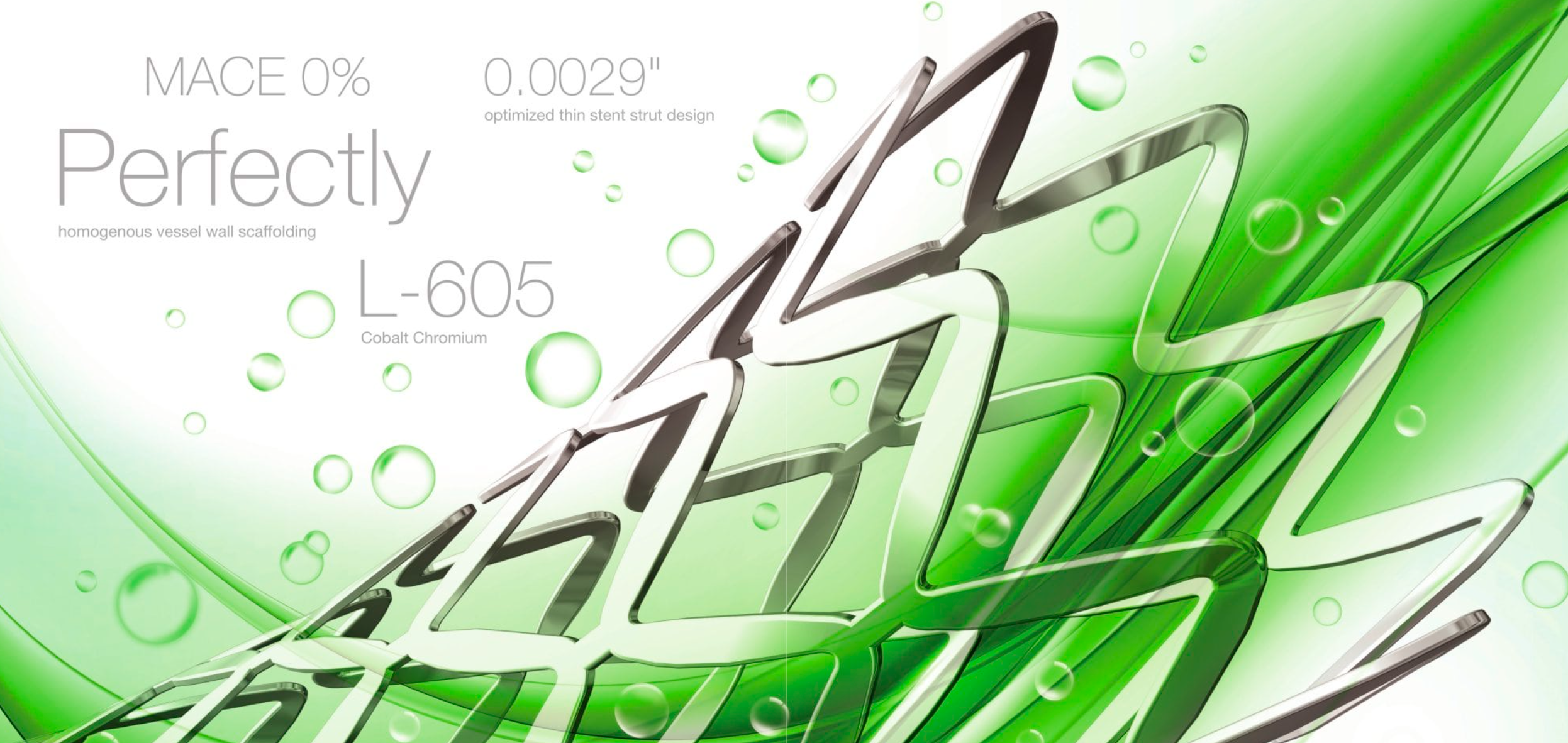
XLIMUS is considered as the ultimate coronary DES stent system to treat complex coronary artery disease by reaching and crossing the most challenging lesions.
Leading the future
of drug-eluting
coronary stenting.
XLIMUS is the ultimate coronary DES stent system to treat complex coronary artery disease by reaching and crossing the most challenging lesions.
XLIMUS offers a stable, flexible stent delivery system featuring a flexible tip technology allowing navigating the most tortous coronary anatomies
XLIMUS is a next generation thin stent strut Sirolimus DES, using the No. 1 drug which demonstrated long-term patient safety and optimal clinical efficacy, in more than 10.0 Million Patients.
No stent flaring.
No tissue prolapse.
Clinically effective.
Homogenous, clinically effective drug delivery optimizes the anti-proliferative protection of the stented lesion segment.
No stent strut flaring. No open gaps.
The technically high standard of 6-8-10 intermediate and closed-cell stent architecture covers all vessel diameters evenly. XLIMUS quality ensures the best possible intracoronary stenting stability and minimizes stenting trauma and restenosis. Extraordinary homogenous vessel wall scaffolding.
XLIMUS assists the cardiologist
with an optimal, unsurpassed tracking performance. It has an innovative Hydrophilic-coated shaft and an extra-low tip profile to access the most tortuous lesions. The ultra-low lesion crossing profile measures only 0.90 mm. The novel XLIMUS Sirolimuseluting coronary stent system protects the stented lesion segment through extraordinary homogeneous vessel wall scaffolding which minimizes the risk of tissue prolapse.
XLIMUS drug-coating
technology
A novel drug-eluting, cobalt chromium coronary stent system, which provides clinically effective antiproliferative, drug delivery to the coronary artery lesion to prevent restenosis, followed by a rapid functional endothelial healing.
Biodegradable Polymer
Sirolimus Drug Elution
Following the nature.
Stent flexibility by design.
Pulse Synchronous Stent Dynamics respond to coronary artery
movement, with every heart beat. Natural stent flexion minimizes friction and shear stress to avoid vessel wall trauma. For a
lifetime patient safety!
Controlled biodegradable Sirolimus drug release for rapid functional endothelial healing.
The highly biocompatible Poly (lactic acid) drug containing release matrix degrades smoothly and provides an optimal release kinetic profile. Within 30 days, about 70% of the anti-proliferative drug is distributed into the surrounding arterial tissue of the stent struts, ensuring a highly effective inhibition of smooth muscle cell migration and proliferation. Pharmacokinetic study result confirm sustained anti-proliferative drug efficacy up to 120 days.
Thin stent struts
minimize foreign body
metal volume.
XLIMUS reduces the inflammatory signal potential for prevention of late restenosis.
Source: Peter Smits,MD, from the COMPARE trial presentation at TCT 2009. *XLIMUS low metal volume stenting. Caution! Thinner struts, much below 71μm may influence stent stability.
XLIMUS controlled
biodegradable Sirolimus
drug release.
XLIMUS ensures a controlled drug release after stent implantation.
The widest range of 72 stent sizes.
Stent
Length (mm)
2.25 mm
2.50 mm
2.75 mm
3.00 mm
3.50 mm
4.00 mm
4.50 mm
5.00 mm
8 mm
XL 2.25–8*
XL 2.50–8*
XL 2.75–8*
XL 3.00–8*
XL 3.50–8*
XL 4.00–8*
XL 4.50–8*
XL 5.00–8*
12 mm
XL 2.25–12
XL 2.50–12
XL 2.75–12
XL 3.00–12
XL 3.50–12
XL 4.00–12
XL 4.50–12*
XL 5.00–12*
16 mm
XL 2.25–16
XL 2.50–16
XL 2.75–16
XL 3.00–16
XL 3.50–16
XL 4.00–16
XL 4.50–16*
XL 5.00–16*
20 mm
XL 2.25–20
XL 2.50–20
XL 2.75–20
XL 3.00–20
XL 3.50–20
XL 4.00–20
XL 4.50–20*
XL 5.00–20*
24 mm
XL 2.25–24
XL 2.50–24
XL 2.75–24
XL 3.00–24
XL 3.50–24
XL 4.00–24
XL 4.50–24*
XL 5.00–24*
28 mm
XL 2.25–28
XL 2.50–28
XL 2.75–28
XL 3.00–28
XL 3.50–28
XL 4.00–28
XL 4.50–28*
XL 5.00–28*
32 mm
XL 2.25–32
XL 2.50–32
XL 2.75–32
XL 3.00–32
XL 3.50–32
XL 4.00–32
XL 4.50–32*
XL 5.00–32*
36 mm
XL 2.25–36
XL 2.50–36
XL 2.75–36
XL 3.00–36
XL 3.50–36
XL 4.00–36
XL 4.50–36*
XL 5.00–36*
40 mm
XL 2.25–40
XL 2.50–40
XL 2.75–40
XL 3.00–40
XL 3.50–40
XL 4.00–40
XL 4.50–40*
XL 5.00–40*
*Upon request, no lead time available
Technical Data
Material
Cobalt Chromium Alloy L-605
Total strut thickness
73µm (71µm Alloy + 2µm coating layer)
Coating layer
2µm
Device lengths
Stent length = balloon length = markers distance
Metal to artery ratio
14% average
Nominal pressure
8 ATM
Rated burst pressure
16 ATM except diameters 4.5 / 5.0 and
diameter 4.0 with length higher than 20mm (14 ATM)